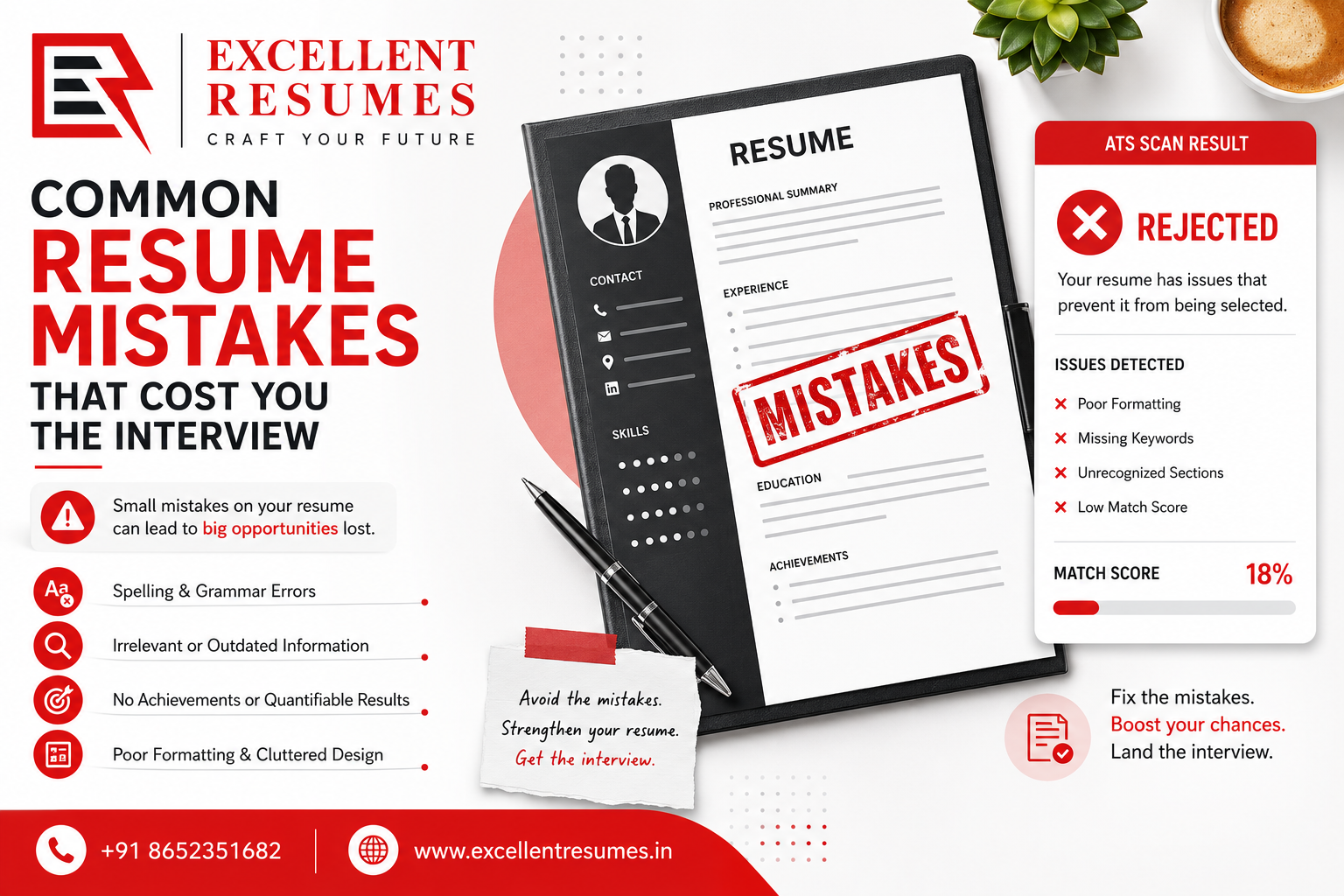
You meet the requirements. Your experience lines up with what the job asks for. And still — nothing. No call, no email, not even a rejection. When this happens across multiple applications, the resume itself is usually where the interview is being lost, not the qualifications behind it.
Recruiters go through dozens of resumes for a single opening, often in a matter of minutes. In that time, small, specific mistakes are enough to move a resume from “worth a call” to “next.” Not big career gaps or missing degrees — small, fixable things that show up more often than most job seekers realize.
Below are the mistakes that come up most often when we review resumes, why each one costs interviews, and exactly how to fix them.
Mistake 1: A Generic Summary That Says Nothing
“Hardworking professional seeking a challenging role to utilize my skills and grow with a dynamic organization.” A recruiter has read a version of that line a hundred times this week. It tells them nothing about who you are, what you’ve done, or why this role fits.
A summary should work like a two-line pitch: your role, your years of experience, and one specific strength or result. Something like: “Digital marketer with 4 years running paid campaigns for D2C brands, managing budgets up to ₹15L per quarter.” That’s a sentence a recruiter can actually use to decide if you’re worth reading further.
Mistake 2: Listing Duties Instead of Results
“Responsible for managing social media accounts” describes a job description, not what you actually did in it. Every bullet point that just restates the role title is a missed chance to show impact.
Compare that to: “Grew Instagram following from 8K to 45K in 10 months through a content calendar built around reels and collaborations.” The second version tells a recruiter what changed because you were there. If you genuinely don’t have a number to attach, describe the specific outcome instead — what got faster, better, or fixed because of the work.
Mistake 3: One Resume Sent to Every Job
Sending the same resume to a marketing role, a sales role, and an operations role rarely works, even if your background technically fits all three. Each job description signals what that specific employer is scanning for — and a resume that doesn’t reflect those priorities reads as generic, even when the underlying experience is strong.
This doesn’t mean rewriting the resume from scratch each time. It means adjusting the summary, reordering bullet points so the most relevant ones come first, and matching the language the job posting actually uses.
Mistake 4: Burying Key Information Below the Fold
Recruiters often decide whether to keep reading within the first several seconds. If your strongest qualification — a relevant certification, a standout project, your most recent and most impressive role — sits at the bottom of page one or on page two, there’s a real chance it never gets seen.
Put your most relevant, most recent, and most impressive information first. Reverse-chronological order for work experience is standard for a reason: it puts what matters most where it gets read.
Mistake 5: Typos and Inconsistent Formatting
A misspelled job title, a mismatched font size between sections, dates that don’t line up — these read as carelessness, even when the candidate is anything but careless. For many recruiters, this is treated as a proxy for how much attention you’ll pay to actual work.
Read the resume out loud before sending it. Check that every date follows the same format, every heading uses the same font size, and every bullet point ends the same way (either all with periods or none). Small, but it matters more than it should.
Mistake 6: An Objective Statement Instead of a Summary
“To obtain a position where I can utilize my skills and contribute to organizational growth” tells a recruiter what you want, not what you offer. Objective statements were standard fifteen years ago. Today, they read as outdated and take up space that could go toward showing your value instead.
Replace it with a short summary focused on what you bring — your experience, your specialty, and a concrete result if you have one.
Mistake 7: Skills Section That’s Just a Word Cloud
A skills section listing “Communication, Leadership, Teamwork, Hard Working, Fast Learner” doesn’t tell a recruiter anything specific, and it doesn’t help you pass an ATS scan for the actual tools and technical skills the role requires.
List real, specific skills — software, tools, technical competencies, certifications — and match them to what the job description is actually asking for. Soft skills belong woven into your bullet points as evidence, not listed as standalone buzzwords.
Mistake 8: Ignoring the Job Description Entirely
Every job posting is a partial answer key. It tells you the exact language, priorities, and skills the employer is scanning for. Resumes that ignore this and rely purely on a generic template miss an easy opportunity to match, both for the human reader and for any automated screening involved.
Before applying, read the posting closely and note the specific skills and phrases repeated in it. Where they genuinely apply to your experience, use that same language in your resume.
Mistake 9: A Resume That’s Too Long — or Too Thin
Cramming fifteen years of experience onto one page can strip out detail that matters. Padding a two-year career to fill two pages does the opposite — it dilutes what’s actually there. Length should match experience: one page for most professionals under 8–10 years, two pages for senior or executive-level backgrounds with genuinely more to show.
How Excellent Resumes Approaches This
When we review a resume, we’re checking for these exact patterns first — generic summaries, duty-based bullets, missing results, formatting inconsistencies — because they’re the fastest fixes with the biggest impact on whether a recruiter keeps reading. We rewrite each bullet around a specific outcome, tighten the structure so the strongest points sit up top, and adjust language to match what the target role is actually asking for.
Frequently Asked Questions
What’s the single biggest resume mistake recruiters notice first? A generic summary or objective statement at the top. It’s the first thing read, and a vague one signals the rest of the resume might be equally generic — even before the recruiter reaches the actual experience section.
Should every bullet point have a number in it? Not every one, but most should show a specific outcome. If a number genuinely isn’t available, describe the concrete result instead of restating the task.
How long should my resume be? One page for most professionals with under 8–10 years of experience. Two pages is standard for senior or executive-level roles with substantial achievements to include.
Is it okay to use the same resume for multiple similar roles? Yes, as long as the roles are genuinely similar in what they require. For roles in different fields or with different priorities, adjust the summary and bullet order to match each one.
Do typos really cost interviews, even for strong candidates? Often, yes. Many recruiters read formatting and spelling errors as a signal of how much care goes into actual work, regardless of how strong the underlying experience is.
Fixing What’s Actually Costing You Interviews
Most of these mistakes aren’t about experience — they’re about how that experience gets presented. Fixing a generic summary, turning duties into results, and tightening formatting can be the difference between a resume that gets skimmed and ignored and one that gets a callback.
If you want a second opinion on which of these mistakes is showing up in your resume, Excellent Resumes can review it and rebuild the sections that are actually costing you interviews. [Get your resume reviewed] and find out what to fix first.